Every Tuesday, this site looks at a training or technology concept that shapes how tennis is played. This week’s inspiration once again comes from the new Netflix docuseries featuring Rafael Nadal. Immediately following the BOSU Lateral Shuffle drill discussed last week, Nadal transitions into another exercise that has become a staple of training coverage on this site: Medicine Ball Groundstrokes.
I have to confess that my first instinct when I saw this clip was to skip it entirely. I have written so many posts about Medicine Ball Groundstrokes that it feels like I might be writing about the same thing over and over. However, this is Rafael Nadal. More importantly, his version has a unique twist that makes it worth discussing.
The foundation of the drill remains the same. Nadal stands a few feet from a wall holding a medicine ball. He rotates into a loaded position, coils through the hips and shoulders, and throws the ball into the wall as if striking a groundstroke. Like the other variations I have discussed previously, the movement reinforces rotational power, balance, and proper kinetic chain sequencing.
However, what is unique, and so very Nadal, is what happens between the throws. After catching the rebound, Nadal does not simply reset and fire the next repetition. Instead, he moves laterally along the wall as if recovering toward the center of the baseline following a shot. Upon reaching that position, he performs a split step and then moves back toward the release point using footwork that closely resembles preparing for the next groundstroke. Only then does he throw the ball into the wall again.

That addition adds another functional tennis movement to the exercise. Traditional Medicine Ball Groundstrokes primarily develop rotational strength and power. Nadal’s variation layers movement and recovery patterns directly into the drill. Instead of training only stroke mechanics, he is also working on one of the most important aspects of tennis. Specifically, that shots are connected by movement.
Many players consider the groundstroke itself a foundational skill, because it is. At the same time, the quality of the shot is strongly influenced by what happens before it. Recovery steps, positioning, balance, and preparation matter every bit as much as the swing. Nadal’s modification leans into that reality.
The split step is particularly interesting. By incorporating it into the sequence, he is reinforcing a fundamental movement pattern that appears constantly during match play. The body learns not only how to generate force through rotation, but also how to organize itself efficiently before the next stroke. Carrying the medicine ball as he does that amplifies the value.
It is no secret that I am a big believer in the importance of medicine balls for tennis training. That remarkably versatile piece of equipment can be used to develop rotational strength, improve balance, reinforce kinetic chain sequencing, and activate the body before competition. It delivers a terrific set of tennis-specific applications for very modest investment.
My own home gym contains an array of medicine balls with varying weights and sizes. They are among my most frequently used off-court pieces of equipment. Consequently, I am thrilled every time another player reveals a new way to use that device.
What I appreciate most about Nadal’s version is that it recognizes an important detail about tennis. Players do not hit shots from stationary positions. They recover, reposition, split step, load, and then hit. By integrating those elements into a single drill, this exercise becomes more than a strength-and-stability builder. It becomes a movement exercise.
Medicine Ball Groundstrokes are hardly new. Yet, Rafael Nadal still managed to show me a variation I had not previously considered.
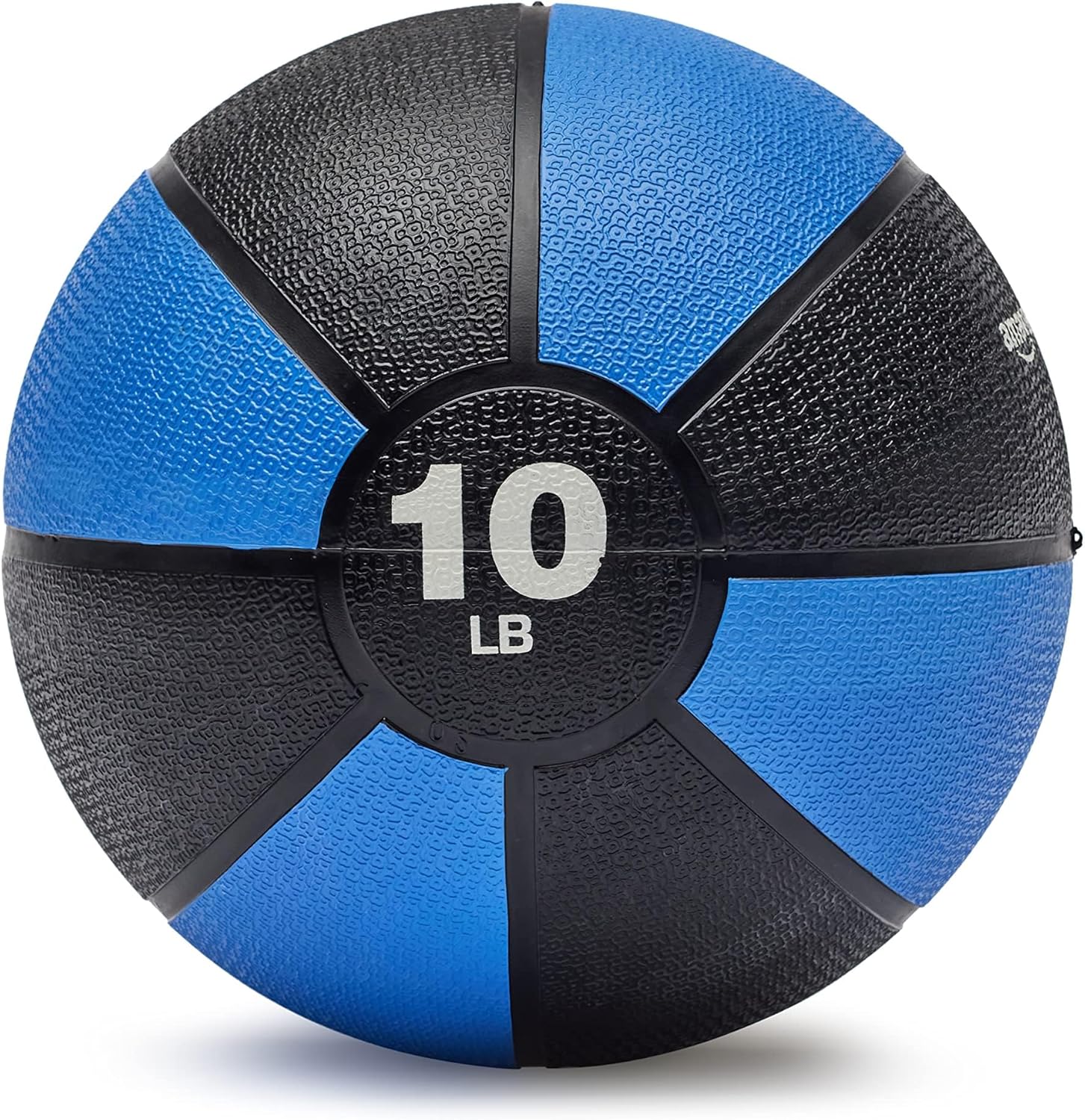
Weighted Medicine Ball (<- Sponsored Link)
Fiend At Court participates in the Amazon Associates program and receives a paid commission on any purchases made via the links in this article. Details on the disposition of proceeds are available on the “About Fiend at Court” page.