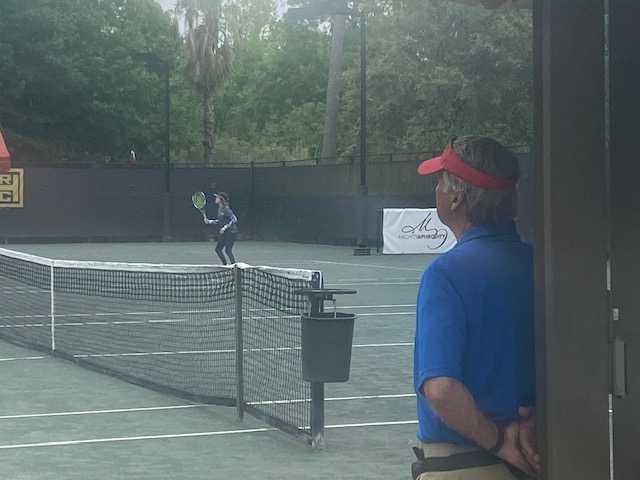
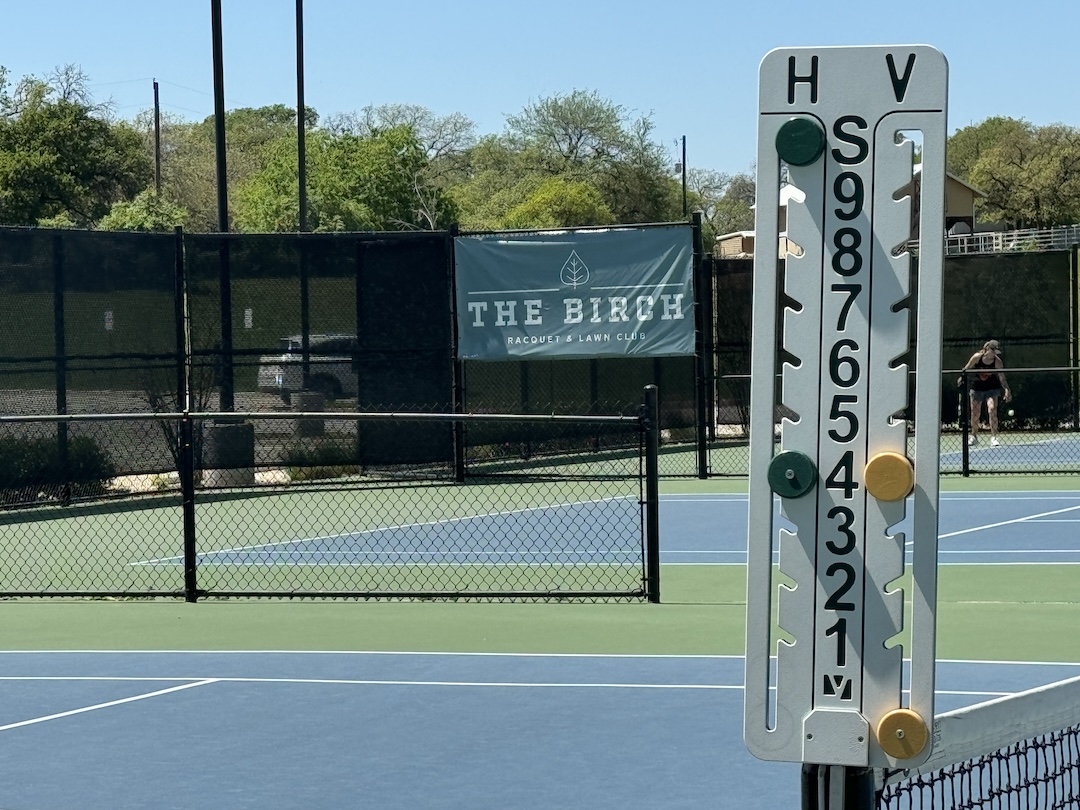
“The windswept plains of North Texas” is a phrase I often use to describe my local playing area. Last weekend, I played a USTA League match on an unusually windy day. A few of the other players remarked that it was the windiest day they had ever played on. For me, I would rank it somewhere between 10 and 20 in my personal experience. Then again, our high school coach my Freshman year once made us practice in a literal dust storm. It was a very bad day for the contact lens wearers, but I digress.
The wind last Friday was strong enough that tennis balls would come to a complete stop only to start rolling again when another gust came along. At one point, the players on the adjacent court had placed their balls on the bench during a changeover. The wind blew them off the bench and onto our court for a rare three-ball let opportunity.
The experience was particularly timely because our sequential examination of The Code has reached Principle 18, which addresses a nuance of this situation.
Let called when ball rolls on court. When a ball from another court enters the playing area, any player on the court affected may call a let as soon as the player becomes aware of the ball. The player loses the right to call a let if the player unreasonably delays in making the call.
USTA Friend at Court 2026, The Code, Principle 18
This is closely related to Principle 17, which we examined over the past two weeks. That principle prohibits players from continuing to play a point and then claiming a let after discovering that the outcome was unfavorable. Principle 18 provides some additional detail about when the opportunity to call a let begins and when it expires.
The wording here is worth examination. Principle 18 refers to the playing area, which extends beyond the painted boundaries of the court. A ball rolling behind the baseline can be just as much of a problem as one rolling across it, particularly if a player is moving in that direction. There is no requirement for the stray ball actually cross one of the court’s lines before someone can call a let.
The second interesting part of the language is that the player may call a let as soon as the player becomes aware of the ball. That is not necessarily the moment the ball enters the playing area. Tennis players generally concentrate on their own match, and another ball can enter the playing area without anyone immediately noticing it.
Once a player does become aware of the stray ball, however, the opportunity to call a let is not indefinite. The rule expressly says that an unreasonable delay forfeits that right.
This brings us back to the wind. Suppose a ball rolls onto the playing area and comes to rest near the back fence. I see it, decide that it is not worth interrupting the point, and continue playing. Several shots later, another gust of wind sets the ball rolling toward my baseline.
My interpretation is that I cannot simply change my mind. I was aware of the ball, had the opportunity to stop play, and elected to continue. The fact that the ball subsequently moved again does not erase that earlier decision. Otherwise, on a sufficiently windy day, I could potentially have several opportunities to reconsider whether I wanted the let.
A subtle nuance is worth considering here. I would be reluctant to argue that a player must ignore a newly developing safety hazard simply because a ball that came to rest near the fence started rolling again. That is different from seeing the ball, deciding to continue, and then invoking its presence later because the point is no longer developing favorably.
Doubles introduces an additional wrinkle. Suppose I notice a stray ball behind our baseline and decide to continue playing. My partner at the net doesn’t see it. Several shots later, my partner runs back for a lob, notices the ball for the first time, and immediately calls a let.
I think that is a valid claim, even though I knew about the ball earlier. Principle 18 says that any player on the court affected may call a let as soon as the player becomes aware of the ball. It does not say that one player’s awareness starts a clock for everyone else. Nor does it say that one partner’s decision to continue playing forfeits the other partner’s opportunity to call a let.
Under that interpretation, my partner has not unreasonably delayed at all. Rather, she just became aware of the ball and acted immediately. The fact that I knew about it earlier does not change when my partner first had the opportunity to make the call.
I can see the counterargument that doubles partners should be treated as a single entity for this purpose, particularly because a let called by either partner affects the entire point. However, I do not see that limitation in the actual wording. Principle 18 assigns the right to call the let to any player, and its timing requirement is expressed in terms of that player’s awareness.
That is my interpretation, anyway. I fully expect that someone will slide into the comments to explain why I am wrong.
The language in this Principle has remained unchanged since at least the 2001 edition of Friend at Court, where it appears as Principle 19. Unfortunately, that historical consistency does not resolve the more unusual situations created by wind, delayed awareness, or doubles partners who notice the same ball at different times.
What I find useful about Principle 18 is that it makes awareness the starting point for the decision. A ball can be present without a player knowing about it, and different players can become aware of the same ball at different times. Once a player recognizes the situation, however, the decision to stop play needs to be made without unreasonable delay.
On the windswept plains of North Texas, where even stationary tennis balls sometimes have a second act, that distinction is relevant.
- Friend at Court: The Handbook of Tennis Rules and Regulations, USTA, 2026
- Friend at Court: The USTA Handbook of Tennis Rules and Regulations, USTA, 2001. (Hardcopy.)