
The 2026 USTA Friend at Court was finally released this week. As is usually the case, there are a few updates, but they are all relatively inconsequential. Once again, our sport remains largely unmodified. However, there are a handful of minor tweaks and clarifications that we will be overthinking in a series of posts that I anticipate will carry us through the end of March. Consequently, we are pausing our sequential walk-through of The Code and turning our attention to what has changed under the USTA’s purview this year.
Earlier this year, when I wrote about the updates to the 2026 ITF Rules of Tennis, I overlooked a clarification made in one of the Case Decisions that defines the ITF interpretation of the foundational rules of the sport. Before we get into that, now is a good time to revisit how the rules framework is structured. The ITF Rules of Tennis are exclusively controlled by the International Tennis Federation. That governing body defines the universal playing rules that apply worldwide.
The USTA does not have the authority to modify or override any of the ITF rules. In fact, the USTA Friend at Court incorporates the ITF Rules of Tennis in full. However, the USTA is authorized to provide interpretation where needed and to specify domestic administrative procedures, tournament regulations, and competition structures. It is always important to remember that the underlying playing rules themselves belong to the ITF.
The update to the 2026 ITF Rules of Tennis that I overlooked earlier this year is a clarification within Rule 18, Foot Fault. Specifically, a previously existing Case Decision was amended with a clarification from the ITF. The red bolded font in the excerpt below highlights the change.
Case 1: In a singles match, is the server allowed to serve standing behind the part of the baseline between the singles sideline and the doubles sideline?
Decision: No. However, in doubles this is permitted.
2026 ITF Rules of Tennis, Rule 18, Case Decion 1
Technically, this clarification does not change anything. Instead, it eliminates any prerequisite to first understand that the doubles alleys are not a part of the singles court. I suspect that some tennis players intuitively understand that. However, I know that some do not.
The reality is that most of us play singles on courts that are also lined for doubles. That can give the mistaken impression that all the marked lines are a part of the full court. However, the singles court and doubles court are distinctly different. In singles, the playable court is bounded by the singles sidelines. The imaginary extension of those lines continues through the baseline. A server’s feet must remain within that extension. Standing behind the doubles alley in a singles match, even though it is behind the permanently marked lines of the doubles alley, is not permitted.
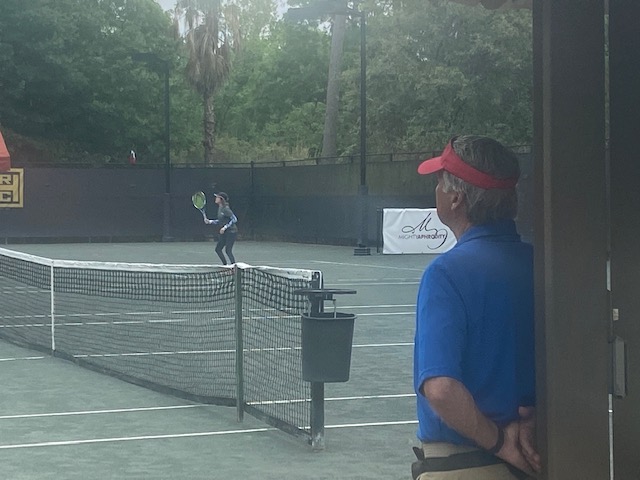
Earlier this year, I played a singles match against an opponent who frequently chose to serve while standing behind the doubles alley. I mentally flagged that position as illegal on her very first serve, but decided not to say anything about it. Her position was clearly outside the singles sidelines, which definitively made every serve from that position a foot fault.
It was clear from the onset of the warmup that the score was going to be pretty lopsided. Additionally, the position she chose was actually disadvantageous, given how we matched up. By moving outside the singles sideline, she was setting herself up for a long run to reach a return down the line or a drop shot, two balls that I am known to hit from time to time.
I didn’t want to start out the match with a pedantic conversation about the intricacies of a rule that was obviously not going to have any bearing on the outcome. As it turns out, I am painfully aware that not everybody appreciates a rules know-it-all.
Reflecting on the update made, I can definitely see how an argument over that rule would have continued to cascade even after consulting the rulebook. The previous verbiage lacked clarity with the one-word answer, unless the reader understood the contextual difference between the singles and doubles courts. Additionally, the ITF does not make changes casually. Thus, seeing the amended clarification in the rules is a strong indication that some players clearly needed it.
In any case, I am moderately embarrassed that I missed that change when I first scanned the 2026 ITF Rules of Tennis. Fortunately, the USTA’s highlights brought it to my attention, so it’s not a total miss.
Over the next several posts, we will work through other changes within the 2026 USTA Friend at Court proper.
- ITF Rules of Tennis, International Tennis Federation, 2026
- Friend at Court: The Handbook of Tennis Rules and Regulations, USTA, 2026


What is a USTA league players ruling on foot faults, when the opposing server foot faults on every
serve what is recourse?
The post “Egregious Foot Faults” breaks that down for you.
… but that is against the Rules! IN doubles you can stand behind the baseline in the alley, but not in singles. In singles you have to stand between the center line and the singles side-line.
Does sharing a rule with a friend or competitor in a positive way label you as a pedant? Knowing and applying the rules make the game better. A server in a singles match, who stands within the doubles alley has a distinct advantage over the receiver if they have an effective kick serve on ad side and a slice serve on the deuce side. If you know a rule, share it, educate the people you play with who don’t know it. If you do so you’re far from a pedant, you’re a promoter.