
Every Wednesday, this site examines a rule or governing principle that shapes how tennis is actually played. We remain in the midst of a sequential walkthrough of The Code, exploring one principle at a time as it appears within the USTA’s Friend at Court. Over the past three weeks, we have examined the current 2026 version of Principle 9 through the lens of doubles play, including who has the authority to make calls, how partners handle internal disagreement, and the awkward dynamics that arise when opponents attempt to pull a partner into a disputed call.
However, there is another fascinating aspect to Principle 9. The modern version is almost unrecognizable compared to how this principle appeared in 2001.
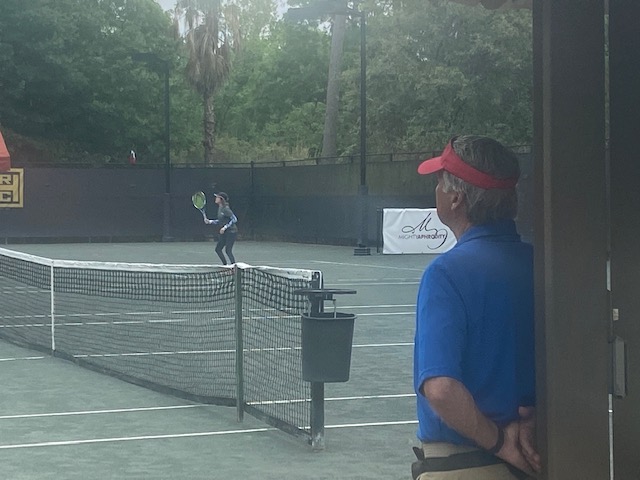
Calls when looking across a line or when far away. The call of a player looking down a line is much more likely to be accurate than that of a player looking across a line. When you are looking across a line, don’t call a ball out unless you can clearly see part of the court between where the ball hit and the line. It is difficult for a player who stands on one baseline to question a call that landed near the other baseline.
USTA Friend at Court 2026 , The Code, Principle 9
Compare that to the 2026 version:
Either partner may make calls in doubles. Although either doubles partner may make a call, the call of a player looking down a line is more likely to be accurate than that of a player looking across a line.
USTA Friend at Court 2026 , The Code, Principle 9
The current version of Principle 9 is effectively a new principle that did not exist in 2001. The original content of Principle 9 was decomposed and redistributed throughout earlier principles in The Code. Concepts that once lived entirely within Principle 9 now appear elsewhere with far greater emphasis. The visible-space requirement migrated into Principle 7. The handling of uncertainty evolved into Principle 8. The practical implications of distance and perspective became embedded across multiple discussions surrounding doubt, certainty, and visual reliability.
The 2001 version of Principle 9 was primarily concerned with educating players about geometry and perception. It reads almost like a miniature lesson in optics. The current 2026 structure assumes that explaining geometry alone is insufficient to manage the real source of conflict in contemporary recreational tennis. Thus, the original visual mechanics gave way to the interpersonal dynamics of doubles play. Specifically, who has the authority to make calls when two players share responsibility for the same side of the court.
The evolution suggests that the authors of The Code stopped viewing the biggest challenge in self-officiated tennis as simply a matter of misunderstanding visual limitations. The emphasis shifted to defining a framework for dealing with situations when more than one player is involved in the decision-making process. Frankly, that feels like a great improvement.
Most experienced players already understand, at least intuitively, that perspective and distance impact perception. The truly difficult situations usually emerge afterward over the interpersonal dynamics of disputed line calls. Viewed through that lens, the evolution of Principle 9 reflects something broader than editorial cleanup. It reflects a changing understanding of where friction actually occurs in self-officiated competition. Earlier versions of The Code devoted more energy toward explaining the physics of vision. Modern versions devote more attention to managing the sociology of shared authority.
After all, the recreational doubles court was never a great place for a geometry lesson anyway.
- Friend at Court: The Handbook of Tennis Rules and Regulations, USTA, 2026
- Friend at Court: The USTA Handbook of Tennis Rules and Regulations, USTA, 2001. (Hardcopy.)
For readers who may be new to the organized tennis landscape, the Friend at Court is the USTA’s compendium of all rules governing sanctioned play in the United States. It includes the ITF Rules of Tennis, USTA Regulations, and additional guidance specific to competition in this country. The Code is nested within the Friend at Court. That section outlines the “unwritten” traditions, expectations, and standards of conduct that guide player behavior. The Code is the ethical framework that shapes how recreational and competitive players conduct themselves every time they step onto the court.


Actually, the doubles court is the perfect place for a geometry lesson, but most players don’t want it!