Over the past three weeks, my mind has been firmly focused on USTA League tennis. As a result, when last week’s featured drill video from USTA Coaching hit my inbox, my mind was primed to view it in a slightly off-label context. Rather than a training game, which is how it was framed in the video, I immediately saw it as a practical warm-up solution for USTA League matches when court availability is limited, and space is at a premium.
Unless you are part of the very first wave of matches each day at a busy facility, it is fairly common to arrive with matches still in progress and no open courts available. In that case, one team grabs a single court as soon as it opens, then tries to figure out how to get a productive warm-up for six to eight players before the scheduled match time.
In those situations, my teams often default to hitting three across on each side of the court. While that setup creates excellent constraints for precision and control on vertical shots, it also produces very narrow lanes. I am always slightly uneasy about safety. When I saw the “Odd Man Out” drill from USTA Coaching, it immediately struck me as a much better alternative for fitting a large number of players onto one court without sacrificing movement or awareness.
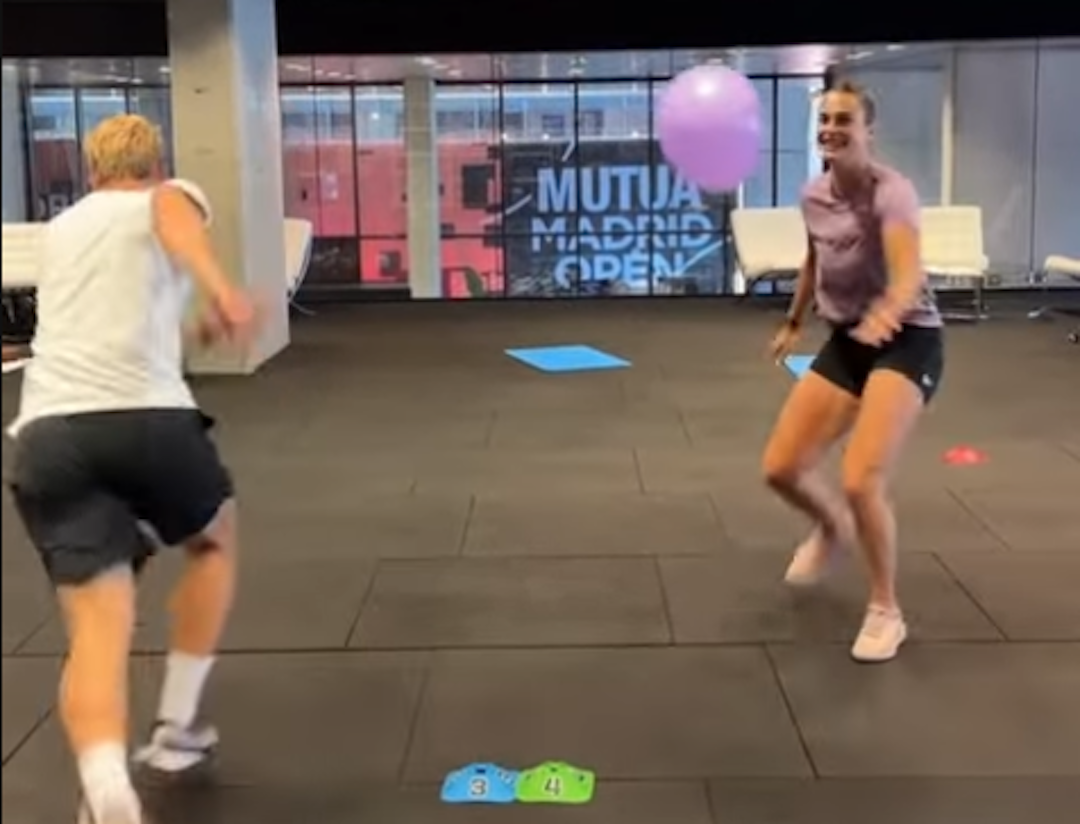
Although the USTA Coaching video frames “Odd Man Out” as a game, it is arguably better described as an active warm-up exercise. The structure is simple. Two players engage in a crosscourt rally, while a third (and potentially a fourth) stands ready with a ball to rotate in. When a player makes a mistake by hitting wide, long, or into the net, that player immediately rotates out. The waiting player steps in and feeds the next ball to restart the rally. Rotations happen quickly, and the outgoing player must immediately retrieve a ball and be ready to reenter. In the USTA video, the three-player rotation was replicated on both sides of the net, but it could also be done with a 3-2 configuration, with no rotations on one side. Various schemes can prevent one player from being locked out if the players on their side keep winning points. As one example, the USTA video suggested that any player who wins three consecutive points also rotates out.
This format adapts easily beyond baseline exchanges. The same structure works well with one side at the net and the other at the baseline to incorporate volleys. It can also be modified to introduce overheads, making it a flexible way to engage multiple players while warming up different movement patterns and strokes.
As a pre-match warm-up for USTA League play, this approach offers clear advantages over hitting straight down the court or cycling players through extremely short individual warm-ups. Players stay engaged, footwork is continuous, and there is far less standing around. Everyone gets touches on the ball without crowding the same narrow space, and the constant rotation gets heart rates up without feeling rushed or chaotic.
This drill also served as a reminder that USTA Coaching itself is a resource worth knowing about. There is a free tier available to any USTA member, and the content extends well beyond drills. While my interest is directly tied to learning more about coaching in anticipation of future community and special-needs tennis engagement after I retire from my day job, the platform clearly offers value to parents helping their children and to adult players who are serious about improving their game.
For those considering coaching as a profession, USTA Coaching also provides higher tiers with structured education pathways, credentials, and professional development tools. The platform ranges from casual learning to formal coaching preparation, making it unusually versatile within the tennis ecosystem.
Ultimately, “Odd Man Out” is a terrific warm-up drill in any context because it is an efficient, adaptable use of court space. As league participation grows and court availability becomes increasingly constrained, methods for maximizing movement, safety, and engagement on a single court are not just convenient but also essential.
I noticed that the Vimeo embed doesn’t always come through, so this is the direct link if you don’t see the full video below.