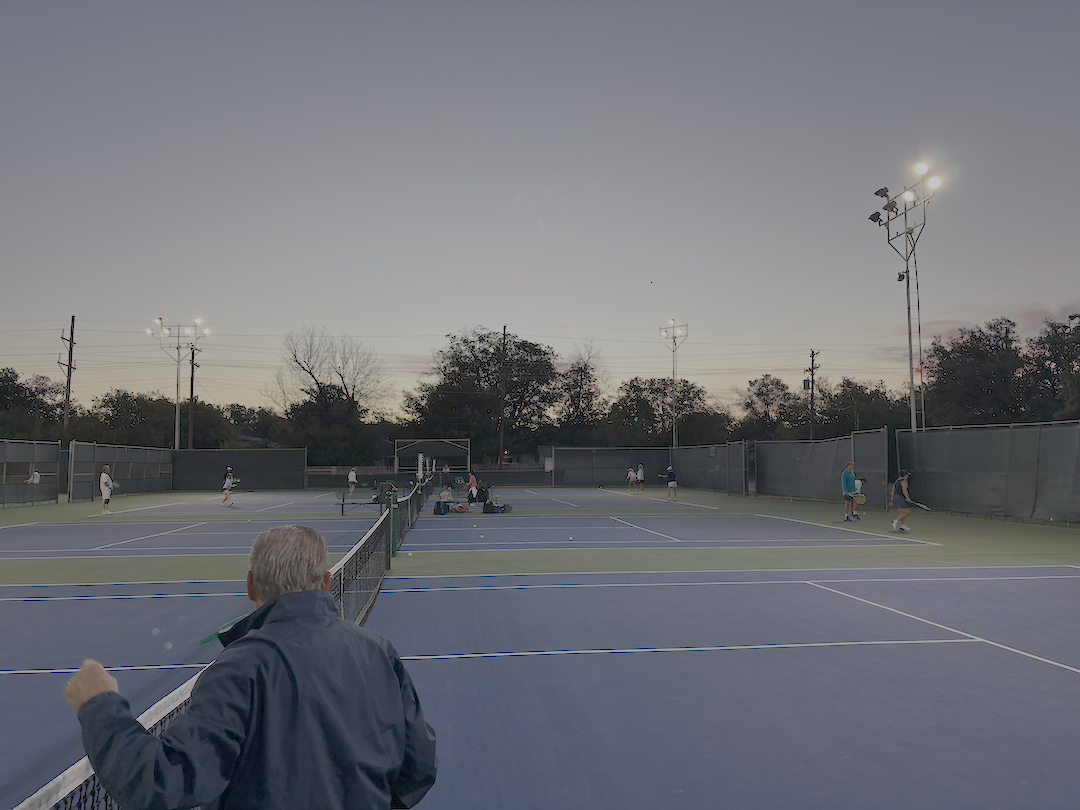
I received a default on my singles line a couple of weeks ago during the opening match of USTA Texas 18+ League Sectionals. When I am not playing, I naturally gravitate toward the courts where the singles matches are being played. My main reason is that singles players are truly alone out there, so it is good to have a teammate nearby in case they need help. I also have a somewhat selfish motivation. As a singles player myself, there is a decent chance that I will eventually face one of the players on the court. I am not one to pass up that scouting opportunity.
During that first matchup, the opposing player hit a first serve that skidded wide and ended up rattling around in the corner of the court. My teammate initially told her that the ball was fine where it was, clearing the server to proceed with her second serve. However, after the server had already begun her second serve motion, the ball rolled back onto the playing area, and my teammate interrupted her so it could be cleared.
Once the ball was removed, the server asked what was essentially a clarification question to confirm that she had been granted a first serve. My teammate disagreed. After a brief debate, the server gave in and hit a second serve.
When my teammate came off the court, she asked me about that situation. I told her that because her opponent had already started her service motion before my teammate interrupted it, a first serve should have been granted. She was mortified.
The next day, a closely related rules question arose, once again with me on the sidelines closely monitoring our singles line. This time, a different teammate was receiving when her opponent hit a first serve wide. As she walked toward the corner to secure it, a ball from the adjacent court trickled over the side fence. Without breaking stride, my teammate tapped that ball back and continued retrieving the original serve.
The server insisted that she was entitled to a first serve because a ball from another court had entered their playing area between serves. My teammate disagreed. The interposing ball had not created any additional delay beyond the time already required to retrieve the original wild serve. Nevertheless, the server confidently asserted that whenever a ball comes onto the court between first and second serves, the server automatically receives another first serve. She was flat out wrong.
This discussion lasted a little longer than the one the previous day and was definitely more tense. Eventually, my teammate gave in and granted a first serve to keep the match moving along.
The two situations are mirror images of the same nuance in the rules. On the first day, the interruption between serves warranted another first serve because the receiver created additional delay after the motion on the second serve had been initiated. The second day, another ball entered the court between serves, but a first serve was not warranted because that ball did not create any additional delay. Paradoxically, in both instances, the player with the correct interpretation eventually yielded to someone who was very confidently very wrong.
Neither situation meaningfully affected the outcome of either match. That is probably fortunate, because there is no competitive injustice here. We are simply left with an example of two experienced players who sincerely misunderstood closely related rules and two other experienced players who were correct but eventually acquiesced.
The players involved all had years of competitive tennis experience. I know for a fact that both players who incorrectly interpreted the rules had played high-level junior tennis, and one played in college. These were not people new to the sport or who hadn’t been around long enough to encounter these situations. Consequently, I was surprised to see either misunderstanding at that level. Seeing both during the same weekend made me think more carefully about what it actually means for a tennis player to know the rules.
Both situations are largely governed by principles contained in The Code, the USTA’s guide for players competing in unofficiated matches. This is front of mind for me because I am currently working through a sequential deep dive of that standard on this site every Wednesday. Among other things, that exercise has revealed that some wording and interpretations of The Code have changed over time.
Specifically as part of that series, I have been comparing the current language with the 2001 version. Most of the principles are essentially unchanged, but we have uncovered a couple of instances where the wording and modern interpretation have evolved. None of the changes I have encountered alter the analysis of these two particular incidents, but they do complicate the assumption that a player who learned the rules years ago necessarily knows the current rules today.
Players are responsible for knowing the rules. For USTA League tennis, the regulatory hierarchy is the ITF Rules of Tennis (recently rebranded to World Tennis) and The Code, both of which are encapsulated within the USTA’s Friend at Court along with current organizational Regulations and interpretations. From there, the rules also include the USTA League National Regulations and, in this case, the USTA Texas Sectional Operating Procedures. If this had been local league or playoffs, some local documentation of the rules would also have been in play. It’s a lot.
That complex framework of documents that are in continuous annual revision means what we remember being taught during junior tennis or what we have done for the past twenty years isn’t necessarily sufficient. Rules knowledge has to be maintained just like any other knowledge that can change over time.
There is another complication. Recreational tennis has a substantial oral tradition surrounding its rules. Players learn from coaches, parents, teammates, captains, opponents, and whatever happened the last time they encountered a similar situation. An interpretation can be passed from player to player for years without anyone going back to the authoritative source to verify it. Eventually, “that’s the rule” can really mean little more than “that’s how everyone I know has always handled it.”
Experience can reinforce the problem. If someone has handled a particular situation the same way for twenty years without being corrected, those twenty years become evidence in their mind that the interpretation must be right. That may help explain what I watched at Sectionals. I have no reason to believe either player was attempting to gain an advantage by knowingly misrepresenting a rule. Both appeared to sincerely believe they were correct at the time.
Recreational tennis is largely self-officiated. In this case, roving officials were present, but not nearby at these critical moments. In both of these cases, the disagreement was resolved through acquiescence rather than an authoritative ruling. The person who correctly knew the rule eventually decided that continuing the argument wasn’t worth it.
I don’t think recreational players need to become walking rulebooks. However, players bear responsibility for maintaining a working knowledge of the rules, while also recognizing when their understanding may be incomplete. Nothing I observed at Sectionals changes my perspective on that.
However, publishing the correct rule somewhere does not guarantee that players will know, understand, or correctly apply it. That becomes particularly challenging when the rules exist across multiple documents that change over time, sometimes with the same requirement repeated in more than one place, and, unfortunately, occasionally with contradictory wording.
If players have a responsibility to know the rules, the organizations administering the sport also have a responsibility to manage and present them effectively. Tomorrow, I want to look at that side of the equation.