
One of the more rewarding things about this site is the feedback I receive from readers. They bring extensive experience as players, captains, and tournament organizers. Many have officiating credentials and bring a perspective informed by formal training and experience applying the rules. Occasionally, someone identifies something I overlooked or offers an interpretation I had not considered. Those exchanges are particularly valuable because they send me back to the source material to examine the topic more closely.
That happened following last week’s post on Principle 18, which addresses calling a let when a ball from another court enters the playing area.
I discussed the distinction between the court and the playing area, pointing out that a ball does not have to cross a baseline or sideline to justify a let. A reader with solid tennis officiating credentials responded by pointing me toward the glossary in Friend at Court, which provides an explicit definition.
Playing Area. The playing area is the area inside the fences or backstops. Any designated seating or standing area is not part of the playing area. When there is a row of courts, the playing area includes the area between courts, but does not include any of the adjacent court or its doubles alley.
USTA Friend at Court 2026, Glossary
That definition adds nuance to my discussion last week, particularly concerning the space between adjacent courts. I appreciate the reader bringing it to my attention.
It also raises an interesting question about how the definition should be applied to Principle 18.
In my local area, it is pretty common for two or more courts to be constructed in a row without a fence between them or any other dividers. Under the glossary definition, if a ball from one court rolls just beyond its doubles alley and comes to rest in the space between the courts, that ball has entered the playing area of the adjacent court, even though it may be nowhere near the players or the ball they are actually playing.
Does that automatically entitle someone on the adjacent court to call a let? A literal reading of Principle 18, combined with the glossary definition, would seem to support that conclusion. The ball entered the playing area, and the player became aware of it. Call the let promptly, and the point is replayed.
I have played at plenty of facilities where that interpretation would produce some rather ridiculous results. Depending on the spacing between courts, a ball might barely leave one court’s doubles alley, but come nowhere near the adjacent one. If every such occurrence justified a let, players could interrupt points over balls that were never remotely close to interfering with play.
That sent me digging further into Friend at Court to see how the term playing area is used elsewhere in the document. It turns out that the term appears in several different regulatory contexts, most of which have nothing to do with stray balls or lets.
For example, the regulations give the referee authority over who may enter the playing area. That makes sense as an administrative boundary. The referee needs to control access to the space where matches are being conducted, not merely the area enclosed by the court lines.
Other provisions use the playing area to regulate when players may leave during a match, obtain assistance, or receive coaching. Medical procedures also refer to the playing area, including requirements associated with cleaning up blood before play resumes. The regulations use the term in connection with certain forms of misconduct, such as deliberately striking or kicking a ball out of the playing area, and with procedural requirements involving appeals.
In those situations, a broad geographic definition serves a fairly obvious purpose. It establishes a boundary that officials and players can identify without having to make subjective judgments.
Principle 18 uses the same term for a different purpose.
Let called when ball rolls on court. When a ball from another court enters the playing area, any player on the court affected may call a let as soon as the player becomes aware of the ball. The player loses the right to call a let if the player unreasonably delays in making the call.
USTA Friend at Court 2026, The Code, Principle 18
Here, the definition becomes part of a decision about whether an ongoing point may be interrupted. The geographic boundary is still relevant, but the consequence of crossing it is considerably different from determining whether a player has left an authorized area or whether a referee may exclude a spectator.
However, there is another phrase in Principle 18 that deserves attention: court affected. The principle does not say that any player who sees a ball enter the playing area may call a let. It says that any player on the court affected may do so.
One possible interpretation is that a ball entering the playing area is itself sufficient to establish that the court has been affected. Under that reading, the glossary provides the boundary, and Principle 18 establishes the right to call the let once a player becomes aware of the ball.
Another interpretation is that the phrase court affected is intended to narrow the circumstances under which a let can be called. After all, a ball might enter the playing area without coming anywhere near the players or interfering with the point. It seems reasonable that the rule would distinguish between a ball that actually affects play and one that simply rolls into the space between two courts.
That second interpretation makes more practical sense to me. At the same time, I cannot point to language in Principle 18 that explicitly requires the ball to interfere with a shot, distract a player, or create a safety hazard. Adding such a requirement would go beyond what the principle actually says.
That is the difficulty. The glossary definition is clear enough, and I see no basis for simply declaring that it does not apply to Principle 18. To be clear, I think it does. However, applying the geographic definition without considering the rest of the principle could permit lets under circumstances that seem entirely disconnected from the purpose.
There are really two separate questions here. Last week’s post focused on when a player becomes aware of a stray ball and how long that player may wait before calling a let. The reader’s observation raises the more fundamental question of what qualifies as a ball entering the playing area in circumstances that justify interrupting a point.
For now, I am inclined to believe that the words court affected have some significance beyond merely identifying which court shares the playing area. Otherwise, the practical effect of the rule could depend heavily on how closely a facility’s courts happen to be spaced. However, that is an interpretation rather than an explicit requirement I can identify in Friend at Court.
Still, I hesitate to reject the literal interpretation just because I don’t particularly like the results. There may be a good reason for drawing a firm geographic boundary rather than asking players to judge whether a stray ball was sufficiently distracting or dangerous. Whatever my preference might be, I haven’t found anything in Friend at Court that clearly establishes a different standard.
This is why I value the comments I receive on these posts, especially from readers who have spent time officiating matches or studying the rules in greater depth. The original observation in the comment was correct, and following it through the rest of Friend at Court exposed a question I had not adequately considered. I would much rather revisit an interpretation than continue repeating one that rests on an incomplete reading of the source.
In the meantime, the reader’s comment has accomplished something useful. What began as a straightforward clarification about the definition of playing area turned into a closer examination of how that definition functions across the regulations, and whether its application to lets is quite as straightforward as it first appears.
- Friend at Court: The Handbook of Tennis Rules and Regulations, USTA, 2026
- Friend at Court: The USTA Handbook of Tennis Rules and Regulations, USTA, 2001. (Hardcopy.)


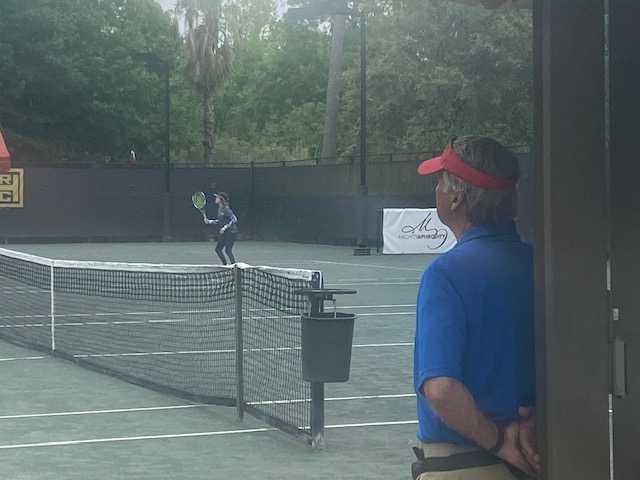
I think “ court affected “ defines that players from an adjacent court cannot call a let on a neighboring court. The affected players must call their own let.
I recognize that it seems like a lot of geography. But exactly how much space is afforded between courts on unfenced banks varies considerably. At a major university, for example, there could be large gaps between courts. At a small municipal facility, it could be very narrow. The rules have to account for all scenarios.
In my view, the phrase “court affected” is not intended to limit the players’ right to call an outside hindrance into their playing area and claim a let.
Here is an important consideration, however. A ball rolling into the playing area does not automatically become an outside hindrance. There is no hindrance if no one is hindered. As you mentioned last week, when a player notices a ball entering the playing area she is given a choice. If that ball has sufficiently distracted her, she can claim an outside hindrance. Otherwise, she must play on and hold her tongue.
You may ask how an official on court would handle a borderline call like this. The answer is that it varies depending on the sanctioning body. The officiating manuals for the USTA, World Tennis, and college (ITA) vary in what thresholds a chair or roving official would use to call a let for a ball entering the playing area. Under the USTA rules, I would probably leave alone a ball that lazily rolls just barely past the next doubles alley. However, if a player on my court called for a let for that same ball, I would have to allow it by rule (except in some point-ending scenarios where it would be too late to claim hindrance).