
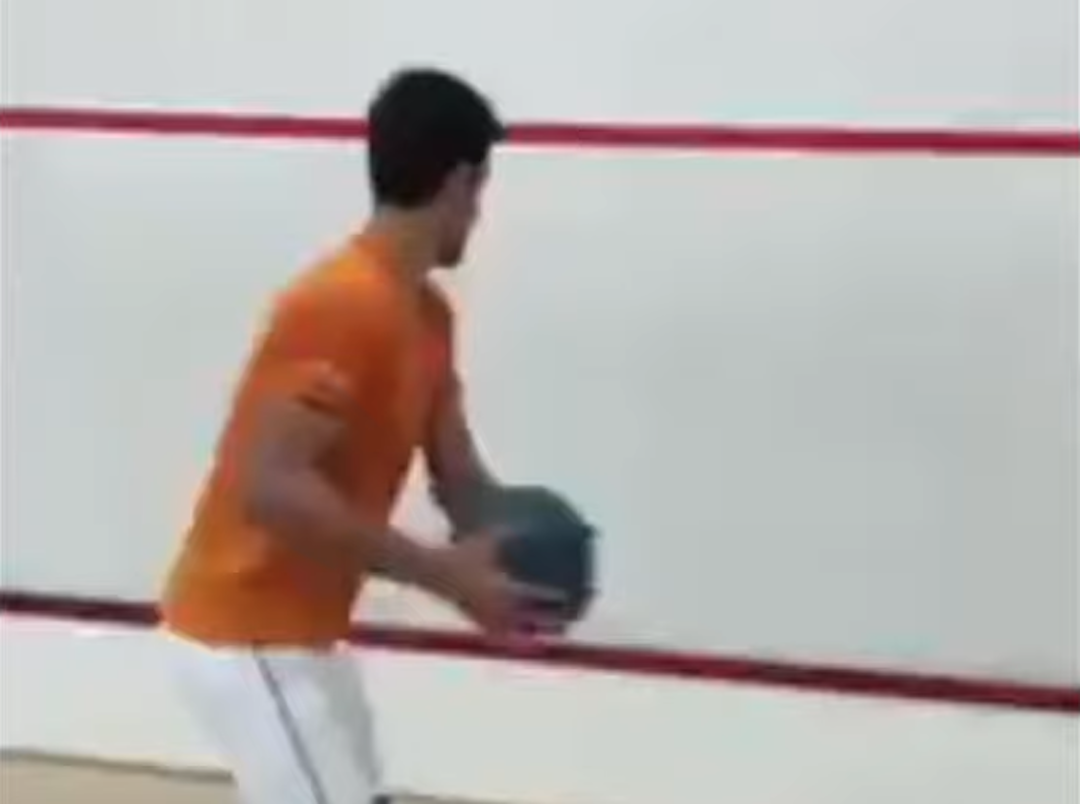
For years, tennis lagged behind other sports on social media. That has recently changed. Not only has tennis developed a meaningful presence on platforms like TikTok and Instagram, but training videos are now showing up regularly in my feed. Better still, some of those are even useful or at least interesting. This week’s example comes from a TikTok video featuring Grigor Dimitrov warming up before a match. While part of what he is seen doing is standard fare, the first exercise in the clip is something I had never seen before. Dimitrov is shown casually tossing and catching a tennis ball while holding a small circular paddle in front of his body.
The circular object he is holding is a handheld ophthalmic eye occluder, sometimes called a paddle occluder. It is a simple opaque circle attached to a short handle. This device is most commonly used in eye exams to cover one eye at a time. While I am familiar with that tool because it is used during my eye exams, this is the first time I have noticed it being used for tennis training.
At first glance, the drill looks almost frivolous. Dimitrov is simply tossing and catching a tennis ball while holding the paddle in his off hand. The critical element is that he is intentionally positioning it at arm’s length to block the central visual field for both eyes. His peripheral vision remains available, but the ball disappears from direct view for part of its flight. Thus, the drill is intended to train his eyes to function accurately when information is incomplete.
Central visual occlusion training is not widely discussed in conjunction with training for tennis, but there are clear benefits for honing that skill for competing in the sport. By blocking the ball momentarily, the brain is forced to rely more heavily on peripheral vision, motion cues, and prediction. Timing becomes anticipatory rather than reactive. It supports the development of recognition without constant visual confirmation.
The relevance to tennis is obvious once you think about it. In match play, players frequently lose direct sight of the ball. Sun glare, shadows, body interposition, or the net cord can all obscure vision of the ball at critical moments. High-level play depends not only on seeing the ball but also on being able to discern its location when visual clarity is briefly compromised.
What makes this drill especially compelling is its simplicity. The paddle itself is a very basic object. There is no technology involved and no elaborate setup. By changing the distance or angle of the occluder, the player can control how much of the ball’s path is hidden and for how long. The constraint is adjustable and highly tailorable.
This is also an easy drill to try at home. A few minutes of gentle tossing and catching a tennis ball while holding an ophthalmic eye occluder at arm’s length creates both challenges and confidence in visual perception. When the occluder is removed, tracking should feel easier. As Dimitrov’s warm-up suggests, developing sharper perception sometimes comes from learning to see, even when your vision is blocked.
Editorial Note: While I included an Amazon link to this device, I used my 3d printer to make the one I am using to experiment with this tennis training technique.

Ophthalmic Eye Occluder (<- Sponsored Link)
Fiend At Court participates in the Amazon Associates program and receives a paid commission on any purchases made via the links in this article. Details on the disposition of proceeds are available on the “About Fiend at Court” page.

Love me some Dimitrov!! This is great info; I rarely watch the ball to the strings. lol
This makes me feel hopeful (though not the point) that it’s not as bad as I thought hahahah
I’ll print one for you and bring it to the next Section meeting. I used a pink/purple gradient filament, and it is the most beautiful eye occluder that you will ever see.