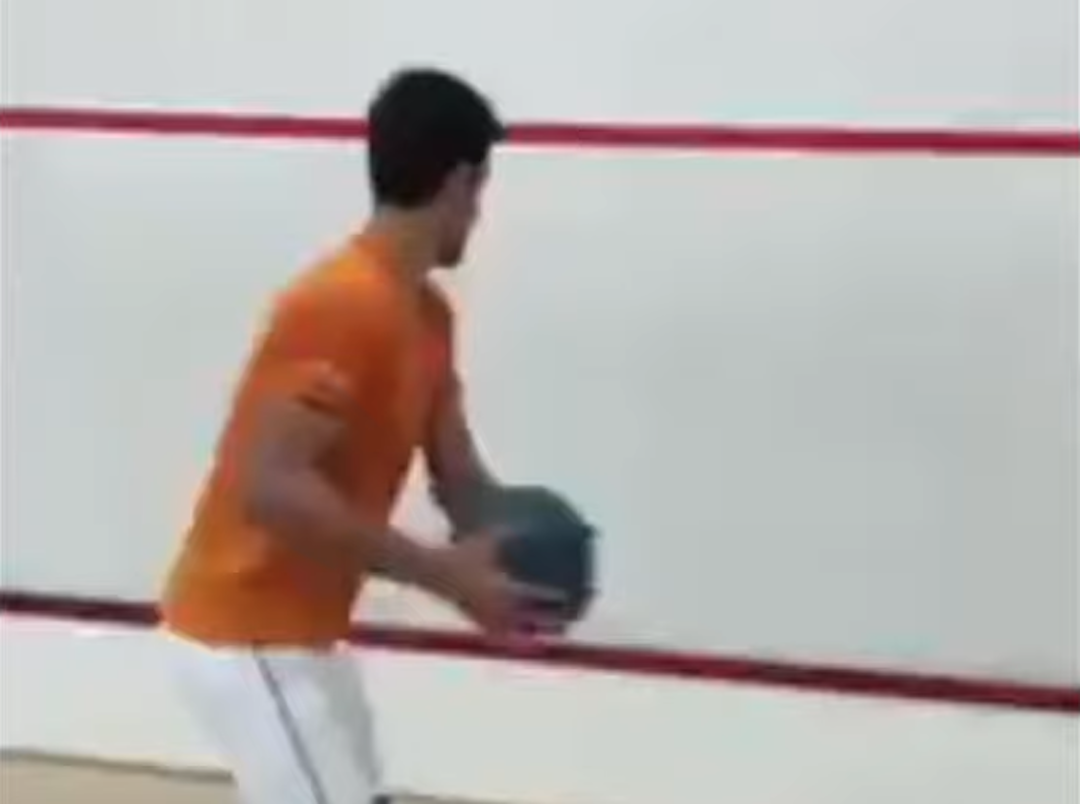
This week’s tennis training topic once again comes from the Netflix docuseries Carlos Alcaraz: My Way. If you’re paying close attention, you’ll notice a sequence where Alcaraz is playing catch with a weighted medicine ball, simulating the torso rotation and arm extension of a two-handed backhand. It’s a simple drill, but it’s highly effective. This topic has been previously covered on this site, but it has been a couple of years. I decided it was high time to revisit this foundational tennis training technique.

Tennis requires quick lateral movement, explosive power, and efficient body rotation. This medicine ball drill checks all of those boxes while also reinforcing balance and stability. In this particular variation, the exercise emphasizes the kinetic chain of the two-handed backhand, loading through the legs, coiling the torso, and extending the arms in a single fluid motion. The weight of the ball magnifies each component, demanding more control and power than a racquet swing alone.
A medicine ball is a weighted rubber ball designed to bounce, but it is heavier than it looks. I keep a small set in my home gym ranging from 6 to 15 pounds, though I most often reach for the 10-pounder. That’s a comfortable weight for most players who want enough resistance to feel the work without losing control of the motion. Watching Alcaraz, it looks like he’s using a smaller ball, maybe in the 3-5 pound range.
One detail worth noting in the docuseries clip is that Alcaraz was using a yellow colored weighted medicine ball. At first glance, that might seem like a purely cosmetic choice, but it carries a subtle advantage. Training with a yellow ball can prime the eyes and brain to track something that more closely resembles a tennis ball in flight. The familiar color reinforces the connection between the exercise and the on-court skill it is designed to enhance. That extra layer of realism is especially beneficial in a drill like this one, where the goal is to simulate the groundstroke. The yellow ball provides not only resistance but also a visual cue that strengthens the mind-body connection between the gym and the court.
To perform this variation, a coach (or partner) feeds the ball into the strike zone on one side of the player. The athlete meets it as though preparing for a two-handed backhand, catching and controlling the load on the backswing, then using torso rotation and leg drive to throw it back. The movement pattern mirrors the stroke mechanics so closely that it’s essentially strength training disguised as tennis practice.

Hand Held Fitness Ball <<- Sponsored Link
It can take a little time to get this drill right. Learning how to synchronize the catch, load, and throw doesn’t always come naturally. But once it clicks, the benefits are undeniable. Medicine ball groundstrokes are a powerful way to build core strength, balance, and movement efficiency while keeping training closely tied to the mechanics of actual play. Alcaraz’s use of this exercise is yet another reminder that even the world’s best pay attention to both the fundamentals and fine details, as exhibited by the color of the ball, which is likely an intentional choice designed to sharpen both body and mind.
If you’re looking for a way to build both strength and stroke mechanics at the same time, this medicine ball drill is a must-add to your training routine. The simplicity of the exercise makes it accessible, but the benefits run deep. Give it a try the next time you’re in the gym or on the court, and pay attention to how your body responds. You might be surprised by how quickly it sharpens your timing and power. And if you already use medicine ball drills, consider experimenting with different weights, or perhaps even a yellow ball, for an extra edge.
Fiend At Court participates in the Amazon Associates program and receives a paid commission on any purchases made via the links in this article. Details on the disposition of proceeds are available on the “About Fiend at Court” page.