The USTA credentialed over 100 social media influencers for this year’s US Open, a decision that drew noticeable attention from the traditional press. Some of the influencers have been disruptive, raising questions about the organization’s credentialing process and the responsibilities that come with media access. At the same time, I have enjoyed the influx of additional content from the tournament on my social media feeds. The coverage of food and drinks around the grounds has been particularly entertaining, and it offers a perspective that traditional tennis reporting has not always provided.
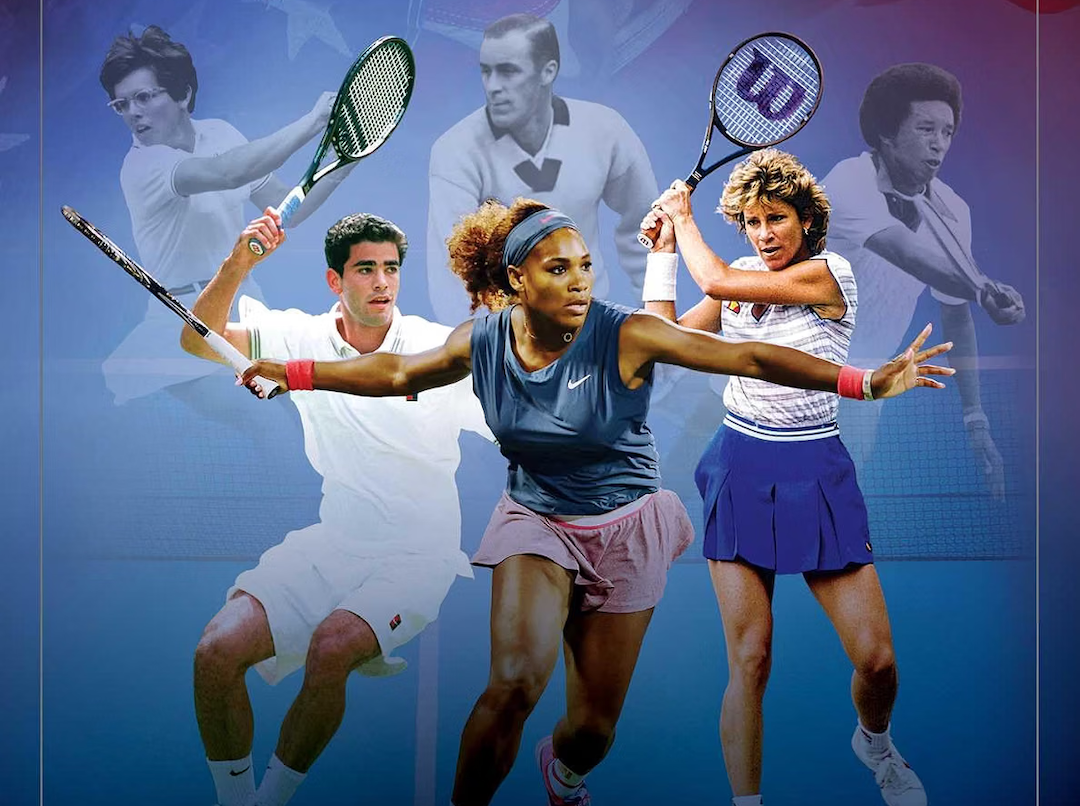
The whole situation made this the right time to cover US Open: 50 Years of Championship Tennis, a book published in 2018 to commemorate the fiftieth anniversary of the Open Era. It represents a very different approach to documenting the tournament from what fans are experiencing this year. The USTA assembled a substantial hardcover volume intended to preserve its history through photographs and essays. I found myself wondering whether the organization will produce something similar for a future anniversary, or whether this kind of commemorative book may eventually become a product of a bygone era.
The book covers the US Open’s first half-century as an Open Era championship. The tournament is considerably older, but 1968 marked the beginning of the period when professionals could compete alongside amateurs. The anniversary volume uses that starting point to trace the event’s development through 2018.
This is primarily a visual history, with photographs occupying much of its pages. The accompanying essays provide context for the players, matches, and changes that shaped the tournament. It is the sort of book that invites browsing, although I found that reading it from beginning to end gave me a better appreciation for how much the US Open has changed during those fifty years.
I particularly enjoyed the material devoted to the construction and transformation of the facilities. The book traces the tournament’s move from Forest Hills to Flushing Meadows and the continuing development of the USTA Billie Jean King National Tennis Center. Seeing those changes documented together provides a perspective that is difficult to obtain from watching the tournament one year at a time.
We tend to become accustomed to facilities fairly quickly. A new stadium opens, a court is added, or part of the grounds is redesigned, and within a few years it becomes difficult to remember what the tournament looked like before the change. The photographs in this book make those earlier versions visible again. They also demonstrate how much of the US Open’s growth has depended upon decisions about the physical space in which the tournament takes place.
The move to Flushing Meadows is an especially important part of that story. It changed the event’s scale and created opportunities for expansion that would not have been possible at Forest Hills. Subsequent construction projects continued to alter the experience for players and spectators. The tournament that we currently experience is the result of decades of decisions about capacity, infrastructure, and how the grounds should function.
The book treats those developments as part of the championship’s history and highlights how stadiums and grounds influence what an event can become. They determine how many people can attend, what kinds of experiences can be offered, and how the tournament presents itself to the world. Looking through the photographs, I was reminded that the US Open’s identity has been shaped as much by the evolution of its facilities as by the champions who have played in them.
The book also provides the expected celebration of the players and memorable moments from the Open Era. There is plenty here for anyone who enjoys revisiting the history of professional tennis, and the photography is outstanding. Some of the images are familiar, but collecting them within a chronological account puts them in their proper context. They become part of the larger story of how the tournament changed rather than simply reminders of individual matches.
As an official USTA publication, the book is understandably celebratory. It is not an investigative history of the organization, nor does it attempt to examine every controversy associated with the tournament. I did not find that particularly troublesome because the book is clear about what it is trying to accomplish. It is a commemorative volume, and its strength lies in assembling a substantial record of the US Open’s first fifty Open Era years.
That brings me back to this year’s influencer hubbub. The arrival of so many new media personalities is another indication of how the tournament is changing, although this time the transformation is taking place in the way the event is presented and consumed rather than in the facilities themselves.
I am not inclined to dismiss the new coverage simply because some of it has been problematic. Traditional journalism remains important, but social media can provide access to parts of the tournament that receive relatively little attention in conventional reporting. I have enjoyed seeing more of the grounds, the food, and the experiences available to spectators. Those things are part of the US Open too, even if they have little to do with who wins a particular match.
The disruptive behavior reported this year raises legitimate questions about credentialing and access. The USTA has to balance the benefits of reaching new audiences against the responsibilities associated with allowing media representatives access that does not respect the match play. That is a separate issue from whether influencer coverage has value, and I suspect the organization will continue adjusting its approach as it learns what works.
What I am less certain about is how this changing media environment will affect the way the tournament’s history is preserved. Social media produces an enormous amount of material, but much of it is intended for immediate consumption. A video may be popular for a few days and then become difficult to locate. Even when the content remains available, it is rarely organized in a way that allows someone to understand the development of an event over several decades.
A book like US Open: 50 Years of Championship Tennis serves a different purpose. Someone has curated the material, placed it in historical context, and assembled it into a record that can be revisited years later. The facilities sections demonstrate that particularly well. Instead of searching for individual photographs of Forest Hills, the original Flushing Meadows grounds, or subsequent construction projects, the reader can follow the progression within a single volume.
That does not mean the next anniversary needs to be commemorated in hardcover. A well-designed digital archive could provide considerably more material and make it easier to explore. The question is whether the USTA will continue investing in that kind of historical organization, regardless of the format, or whether future anniversaries will be marked primarily by content created for immediate distribution.
I would like to think there will still be a place for books like this. There is something satisfying about being able to pull a substantial volume from the shelf and spend an afternoon looking through the history of a tournament. More importantly, the format encourages a kind of sustained examination that is different from scrolling through a collection of unrelated posts.
US Open: 50 Years of Championship Tennis is an enjoyable addition to my tennis library, particularly because of its treatment of the facilities and the physical transformation of the tournament. It is a celebration rather than a critical history, but it succeeds at preserving a substantial portion of the US Open’s first fifty Open Era years in a form that remains useful well beyond the anniversary itself.
I am enjoying the additional content coming out of this year’s tournament, but at the same time I expect the ways we consume tennis will continue to change. Whether the USTA produces another book like this for a future anniversary remains to be seen. For now, I am glad it produced this one.

US Open: 50 Years of Championship Tennis (<- Sponsored Link)
Fiend At Court participates in the Amazon Associates program and receives a paid commission on any purchases made via the links in this article. Details on the disposition of proceeds are available on the “About Fiend at Court” page.