
Every Wednesday, this site delves into a rule or governing principle that shapes how tennis is actually played. We are in the midst of a sequential walkthrough of The Code, the USTA’s ethical framework that shapes how recreational and competitive players conduct themselves every time they step onto the court. This post is a follow-up to last week’s examination of Principle 7. For reference, that Principle places strict requirements on players to clearly see space when calling balls out.
Ball touching any part of line is good. If any part of a ball touches a line, the ball is good. A ball 99% out is still 100% good. A player shall not call a ball out unless the player clearly sees space between where the ball hits and a line.
USTA Friend at Court 2025 , The Code, Principle 7 (Complete)
After thinking about last week’s post for a few days, I began to seriously doubt that I actually meet that standard when returning serve. Spoiler alert, I do not. I can say that with certainty because I did a personal experiment last weekend. I placed seven tennis balls at varying distances just beyond the service line. They were all out, though one would probably be in due to compression on the bounce had it actually been in motion. The other six were clearly long.
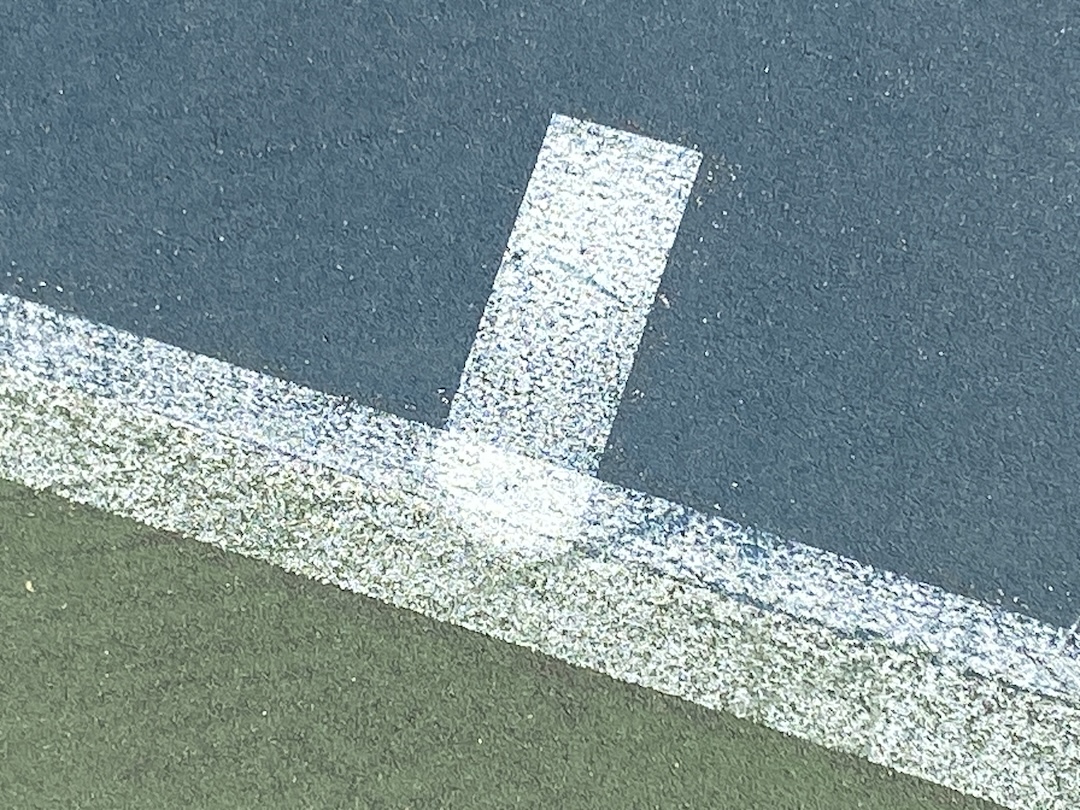
When I stood on the baseline, which is where I typically stand when returning serve, there was no visible separation. The first photo below was taken from that vantage point. In fact, it is actually worse than that because that was at full vertical posture rather than crouched in the ready position, which would lower my eyes by a few inches. The second photo was taken almost directly above the balls, but still slightly behind them.


From the first perspective, I cannot clearly see any separation on any of those balls. Yet, I would almost certainly call at least one of those balls out in real match play. The second photo shows the true distance behind the line.
That realization was unsettling. Principle 7 does not allow approximation. It does not say “if it looks out.” It says the player shall not call a ball out unless the player clearly sees space between the ball and the line. From the returner’s geometry at the baseline, that standard is far more demanding than I suspect most of us acknowledge.
There is also a separate physical truth here. Taller players enjoy a marginally better angle to see space between the ball and the line. That advantage is not about skill or honesty but rather geometry. The lower the viewing angle, the more the ball visually compresses into the line.
I was also struck by the fact that nobody challenged me last week when I emphasized the visible-space requirement. Not in conversation, not in comment, not in private message. My suspicion is that many players nod at the rule in theory while not actually applying it in this specific context. In fact, it took me almost a week of reflection to realize that I was not consistently meeting the standard in Principle 7 on that particular shot.
For sideline calls, the geometry is more forgiving. The ball is usually on the far side of the line from the caller’s perspective, thus the line and any space is not obscured by the ball. On baseline shots during rallies, players are often much closer to the bounce when making the call, which helps with the angle. However, service returns are different. The receiver is farther from the service line, with their sight partially blocked by the ball as it skids or kicks. It’s a tough call to make.
All of this leaves me with uncomfortable questions. Is the requirement to clearly see separation, at least on service returns, an impossible standard? The rule is clear, but if the standard is visible space, how often do we truly have it, particularly on a return of serve?
I am not comfortable with the idea that Principle 7 might be aspirational.
This is also another example of the differences between singles and doubles. In singles, the player has no help when calling serves. In doubles, a partner stationed near the service line is positioned at a much better angle to see separation. Perhaps the correct takeaway is that more service returns in singles should be played than are currently being called out.
That being said, I do not intend to change my personal standard. If anything, I play some serves that are slightly long, but also call some that I am confident missed the line. That requires me to admit that I do not always meet the standard of Principle 7.
I am genuinely interested in alternative reactions. If you have a different experience, perspective, or if you think this experiment misses something fundamental, I would welcome your feedback. Principle 7 is written around human limitations, but for now, in this particular context, human limitations seem to overwhelm the standard.
- Friend at Court: The Handbook of Tennis Rules and Regulations, USTA, 2025
- Friend at Court: The USTA Handbook of Tennis Rules and Regulations, USTA, 2001. (Hardcopy.)
For readers who may be new to the organized tennis landscape, the Friend at Court is the USTA’s compendium of all rules governing sanctioned play in the United States. It includes the ITF Rules of Tennis, USTA Regulations, and additional guidance specific to competition in this country. The Code is nested within the Friend at Court. That section outlines the “unwritten” traditions, expectations, and standards of conduct that guide player behavior. The Code is the ethical framework that shapes how recreational and competitive players conduct themselves every time they step onto the court.


The written rule fails to specify that this instruction can only be executed with reasonable accuracy by a team of line judges each dedicated to a single line, positioned outside the court, as used to occur in professional tennis at the highest level. The alternative is a system of cameras and computer processing of the images. Obviously, us normies play the vast majority of our tennis without the benefit of these luxuries.
The rule also neglects to mention that a player is highly unlikely to be in that correct vantage point while executing their shot, and thus must adjust their call according to the geometry of the situation. There will be some scenarios where an out ball looks good to you, like the one that you set up in the photos returning serve as a singles player. However, the majority of scenarios will be that the ball looks out to you and you are mistaken. This is especially true of the well-meaning doubles net partner who is trying to help their baseliner judge a shot they are fielding near the baseline or their sideline. Personally, when I’m that net player I rarely commit to out calls that are not my business. I am much more likely to say that I couldn’t see it accurately from where I was, so benefit of the doubt goes to the opponent.
The ability to see the “out space” specified in the rule depends on your vantage point. We generally have calls being made by one or two moving players who are hopelessly out of position for the job. The distance, angle, speed and spin of the ball can work to create a scenario that your brain cannot accurately see, and yet our visual system operates in a way that the brain will generate a plausible but inaccurate image from limited data. We perceive this image to be true, so we “see a space,” but our image is actually objectively false. Such a dirty trick that the brain plays on us there. It’s like our brain gives us a crummy AI type image that is not labelled as such. I find that most tennis players don’t know that this can and frequently does happen as we are playing. (BTW, this effect explains why returning serve is so difficult against unfamiliar opponents because our brain is generating fake images based on data from players we have experience with.)
Certain player/line relationships are especially prone to egregious calls. The opponent is genuinely robbed of a point they have earned and feels legitimately upset, meanwhile the player making the call feels they have done the best they can to call it correctly. Play enough USTA tennis, which you perceive as “counting,” and you start to think everyone is cheating and that league play is no fun. Everyone starts showing up with a chip on their shoulder before the match even starts.
Fault Tolerant Tennis has an excellent introduction to this subject of visual processing errors. https://faulttoleranttennis.com/the-saccadic-tracking-loop/