Last Thursday, when I introduced the 2026 Tennis Glow-Up project, I mentioned my recent tradition of creating an annual recurring series of posts inspired by a non-tennis book that can be leveraged to meaningfully enhance our experience in the sport. This title was the one I most strongly considered. What ultimately gave me pause was not its relevance, but its scale. I struggled to see a way to build a year-long project around it without oversimplifying its core ideas. So rather than forcing it into that structure, I decided to review it separately.
The Fifth Discipline is a foundational work on systems thinking and organizational learning. Peter Senge introduces five disciplines that define what it means to be a learning organization: Personal Mastery, Mental Models, Shared Vision, Team Learning, and Systems Thinking. The fifth discipline is not simply another pillar. It is the glue that binds the other four together. Systems thinking provides the framework that allows individual growth, collective vision, and team learning to cohere into something durable. Without it, the other disciplines exist in isolation and never fully realize their potential.
For decades, The Fifth Discipline has been one of the five books I universally recommend to my mentees and when I give career development talks to technical audiences. Historically, that recommendation has come with a small apologetic disclaimer. The reason this book is so valuable to people in technical domains is the way it teaches systems thinking, even though it does so through concepts like personal mastery, shared vision, and dialogue. Engineers are not always instinctively receptive to what they perceive as “soft” material. For years, I searched for a book that taught systems-oriented thinking as well as Senge’s book. Though I read widely, I never found anything that could displace it from my recommended book list. There is no better resource for learning systems thinking.
I reread The Fifth Discipline in preparation for this review. More accurately, the book I recently read was the 2006 revised edition, not the original 1990 hardcover that has graced my office shelf for decades. I was aware the new edition existed, but assumed it was largely interchangeable with the original. That is true, to a point. The newer edition includes more than one hundred pages of additional material. In retrospect, it is mildly embarrassing that I had not upgraded sooner. My switch to the updated version happened only because I accidentally left my physical copy at work before the holiday break and opted to buy the Kindle version rather than making a special trip to retrieve it. I am grateful for the accident.
If the paid staff and volunteer leadership within the USTA embraced the principles in this book, many of the current challenges facing tennis governance and advocacy would become more clear. More importantly, the path toward building something stronger would be easier to see. Over the life of this blog, I have written extensively about how the lack of systems-oriented thinking cripples efforts to support tennis. This book speaks directly to that failure. It reveals how structure and siloed tasking isolate people from the larger whole, severing the feedback loops that allow learning to occur. When individuals focus only on their position, they lose any sense of responsibility for the outcomes produced when their work interacts with others. Teams can only learn if they can see and experience the consequences of their decisions.
A recurring theme in the book is the importance of dialogue and the ability to speak across our differences rather than allowing them to calcify into identity and polarization. Learning organizations do not emerge from agreement but rather shared inquiry. Tennis desperately needs more conversations rooted in lived experience rather than further subdivision into functional or ideological silos.
Some of the additional material Senge introduced in 2006 feels especially prescient in today’s political climate. One passage stopped me cold:
In an increasingly interdependent world, it is ironic that many of our societies are becoming more fragmented and polarized. In one sense, this is understandable. When one is facing complex issues that engender considerable fear, there is security in being able to pull back into a particular ideology, a one true answer. But one group’s ideology is rarely shared by others, and consequently, walls develop between groups. After a while, ideology becomes identity, and polarization becomes self-reinforcing.
That observation applies as much to institutions as it does to societies. When organizations struggle with complexity and information overload, the instinct to retreat into simplified answers feels proactive, but it is often reactivity in disguise. True proactiveness, as Senge frames it, comes from seeing how we participate in creating our own problems rather than fighting an external enemy.
One of the most powerful ideas in the book is Senge’s framing of mistakes. Errors are events whose full benefit has not yet been extracted. Learning comes from converting experience into insight. This matters deeply for tennis. Experimentation must be allowed. Not every initiative will produce the desired effects, and that must be an acceptable part of the process. When everything “succeeds,” learning stops. When organizations fear failure, they guarantee that very thing.
Learning, in Senge’s view, has no finish line. Teams do not begin as high-performing entities. They learn how to produce extraordinary results. Individual learning matters, but without team learning, organizations cannot thrive. Meaningfulness, connection, and shared purpose are not optional add-ons. They are the conditions under which sustained excellence becomes possible. Feedback, the reciprocal flow of influence, is what allows systems to see themselves.
I recommend this book to everyone, especially those involved in tennis advocacy. While I ultimately decided not to build a regular publishing cadence around it this year, its ideas will continue to surface throughout the coming months. This book transformed how I think about work, organizations, and responsibility. It can do the same for you, and it can do the same for tennis.
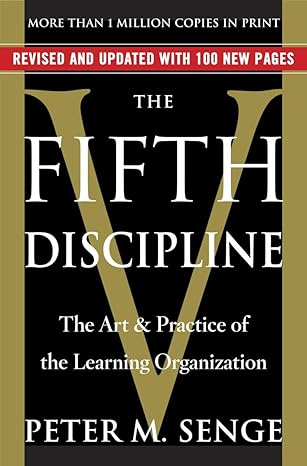
The Fifth Discipline: The Art & Practice of The Learning Organization (<- Sponsored Link)
Fiend At Court participates in the Amazon Associates program and receives a paid commission on any purchases made via the links in this article. Details on the disposition of proceeds are available on the “About Fiend at Court” page.