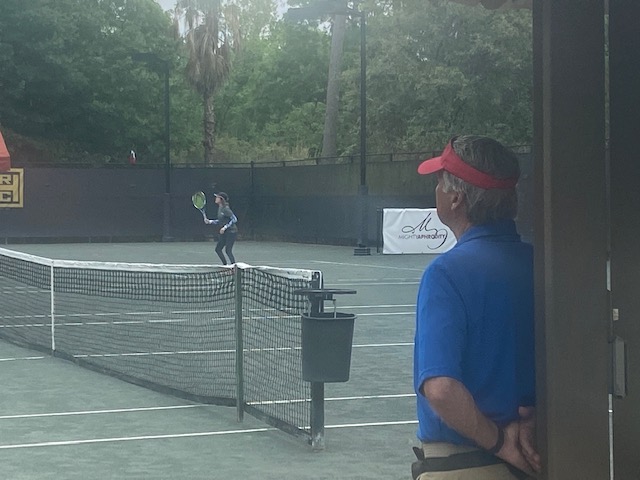
Every Wednesday, this site examines a rule or governing principle that shapes how tennis is actually played. This week, we remain in the midst of a sequential walkthrough of The Code, exploring one principle at a time as it appears within the USTA’s Friend at Court. After working through how the sport resolves uncertainty in Principle 8, we now move on to Principle 9, which introduces unique dynamics of doubles play. Specifically, what happens when more than one person can potentially make a line call?
Either partner may make calls in doubles. Although either doubles partner may make a call, the call of a player looking down a line is more likely to be accurate than that of a player looking across a line.
USTA Friend at Court 2026 , The Code, Principle 9
There is a familiar argument that tends to surface around this Principle, particularly in doubles. A ball lands near a baseline or sideline, and the opposing team challenges the call with a variation of the same idea: “You were too far away to make that call,” or “Your partner was much closer than you and should have been the one to do it.”
On its face, that argument has intuitive appeal. Specifically, both the distance and the angle make a difference. As we have already explored in this series, the geometry of vision can make it more difficult to see separation from certain positions on the court. A player standing closer to the line, or looking down the line rather than across it, may very well have a better view, but not necessarily so. What Principle 9 makes clear is that even when one player ostensibly has a better perspective, it does not mean they exclusively own the right to make the call.
This is a topic that hits close to home for me in a very literal sense. I wear progressive lens bifocals, which give me a couple of blind spots depending on where the ball passes through my field of vision. In particular, balls that land at or near my feet can be surprisingly difficult to call. Even though I am standing right on top of the bounce, the transition zone in the lenses can blur the line just enough that I cannot make a confident call either way. It is a useful reminder that proximity does not guarantee clarity. In some cases, the player closest to the ball may actually be the least certain.
The Code is explicit that a player is responsible for calling balls on their own side of the net. That responsibility does not shift simply because someone believes that another had a superior vantage point. It is a subtle but important distinction because allowing authority to transfer based on perceived vantage point would create more problems than it solves. Players would begin negotiating not just the outcome of calls, but who is entitled to make them. Every close ball would invite a secondary debate about positioning, angle, and perspective. Matches would not only be decided by calls, but by arguments over who had the “right” to see the call in the first place. That is not a workable system.
Instead, The Code takes a different approach. It acknowledges that perspective can be imperfect, but it places the burden of applying the standard of everything we have already discussed. They must recognize the limits of their view. They must account for the possibility of doubt. They must only call a ball out if they clearly see separation. If they cannot meet that standard, the ball is good.
This is what often gets lost in the “you were too far away” argument. The distance is already accounted for in the standard itself. A player who is far from the line has a higher burden of certainty, not a diminished right to make the call. The farther the player is from the bounce, the more conservative they should be. That is how the system maintains fairness without redistributing authority.
That may not always feel satisfying in the moment. Players will continue to believe that someone else may have had the better view. In many cases, they may even be correct. But the strength of perspective is not the same as certainty. The Code prioritizes a process that is consistent, repeatable, and resistant to negotiation. Without that, every close ball becomes two arguments instead of one. It is never a good idea to add a second debate to the first one.
Next week, we will stay within Principle 9 but shift the focus. What happens when one player makes a call, but their partner saw it differently?
- Friend at Court: The Handbook of Tennis Rules and Regulations, USTA, 2026
- Friend at Court: The USTA Handbook of Tennis Rules and Regulations, USTA, 2001. (Hardcopy.)
For readers who may be new to the organized tennis landscape, the Friend at Court is the USTA’s compendium of all rules governing sanctioned play in the United States. It includes the ITF Rules of Tennis, USTA Regulations, and additional guidance specific to competition in this country. The Code is nested within the Friend at Court. That section outlines the “unwritten” traditions, expectations, and standards of conduct that guide player behavior. The Code is the ethical framework that shapes how recreational and competitive players conduct themselves every time they step onto the court.