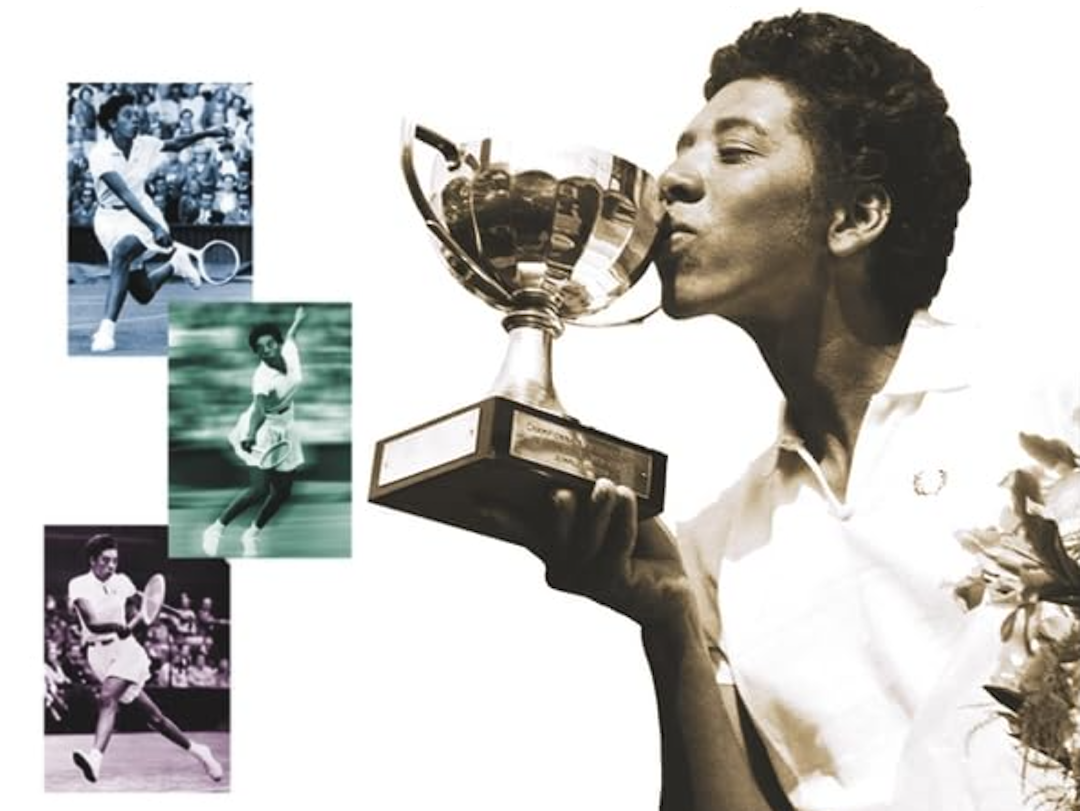
There are certain figures in tennis history whose names mark a before-and-after. Althea Gibson is one of them. Before Gibson, the highest levels of American and international tennis remained effectively closed to Black athletes. After Gibson, the sport could no longer pretend that talent was confined to the segregated boundaries it had constructed.
Gibson’s breakthrough was not symbolic. It was competitive. She won the French Championships in 1956, becoming the first Black player to capture a Grand Slam title. She followed that with Wimbledon and U.S. Championships singles titles in 1957 and 1958, finishing as the world’s top-ranked woman. Her victories forced tennis institutions to confront their own exclusionary practices, and her presence reshaped the possibilities for future generations.
Her importance extends beyond the trophies. Gibson’s rise required advocacy, resilience, and community support within a system that was slow to change. She navigated the intersections of race, class, and gender in mid-century America while competing in a sport that prided itself on decorum but often resisted equity. Without Gibson, it is difficult to understand the later careers of players like Arthur Ashe or the broader arc of integration in American tennis.
The encouraging news for readers is that Gibson’s life has been examined from multiple angles. There is no single definitive lens. Instead, a growing shelf of books offers complementary perspectives on her legacy. Below are capsule summaries of several that I have previously reviewed.
The Match: Althea Gibson and a Portrait of a Friendship by Bruce Schoenfeld tells the story of Gibson through the lens of her unlikely doubles partnership with Angela Buxton. Rather than offering a conventional cradle-to-champion biography, Schoenfeld centers the narrative on the bond between two players who were each treated as outsiders within a conservative tennis establishment. Their 1956 French Championships doubles title becomes more than a tournament victory. It is portrayed as a moment of shared defiance and mutual loyalty that helped propel Gibson toward her breakthrough singles triumphs. I originally reviewed this book on February 11, 2021.
Althea: The Life of Tennis Champion Althea Gibson by Sally Jacobs offers a sweeping narrative of Gibson’s journey from Harlem childhood to world No. 1. Her ascent is situated within the broader social and political currents of mid-20th-century America, blending rigorous research with accessible storytelling. The book does not stop at the height of her fame but also examines the complicated years that followed, presenting a portrait that is both celebratory and clear-eyed. I originally reviewed this book on August 24, 2023.
Serving Herself: The Life and Times of Althea Gibson by Ashley Brown emphasizes both Gibson’s competitive accomplishments and her personal evolution. This book explores the racial barriers Gibson confronted, her Grand Slam triumphs, and her efforts to redefine herself beyond tennis, including her career in professional golf. The result is a textured biography that highlights resilience without simplifying the complexities of her later life. I originally reviewed this book on February 23, 2023.
I Always Wanted to Be Somebody by Althea Gibson remains foundational because it allows Gibson to tell her own story. The autobiography captures her voice at the height of her success, recounting the grit, ambition, and determination that carried her from Harlem playground courts to the lawns of Wimbledon. It provides immediacy and personal context that later biographers build upon. I originally reviewed this book on February 3, 2022.
Any one of these books is a strong starting point for readers who want to better understand the tennis legend and the era she helped transform. Together, they form a layered portrait of a champion whose impact extends far beyond match scores. And yet, there is another book on Althea Gibson that I have not yet reviewed. That will change next week. Consider this your heads-up that the next installment in this series will take a closer look at one more book to round out our exploration of one of the most consequential figures in tennis history.
Fiend At Court participates in the Amazon Associates program and receives a paid commission on any purchases made via the links in this article. Details on the disposition of proceeds are available on the “About Fiend at Court” page.